Saturday, July 22, 2017

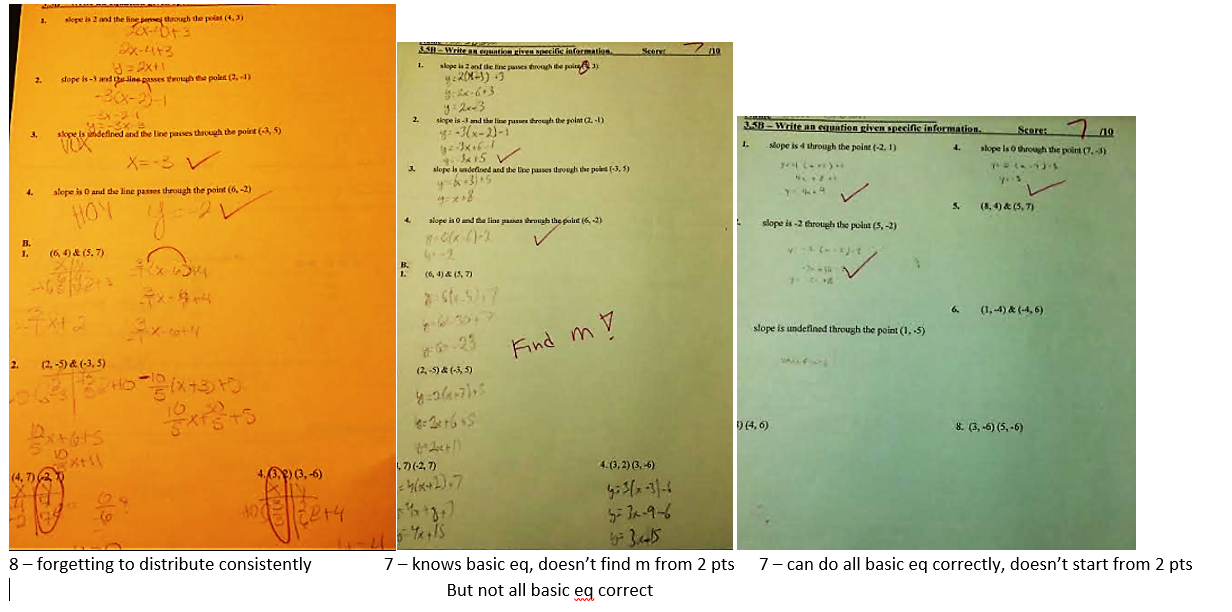
Examples of my 5 - 10 SBG rubric in practice.

  •           Definitely check my prior post on my reasoning about how I grade. These are just some examples. 
  •     The important thing is being consistent with yourself with students' tests and across retesting. We might disagree within .5 (that’s the smallest increment I give) but overall students will end up grade-wise being about where they should be A = full grasp of all/almost all content in the course B= strong grasp of content with some gaps/misunderstandings etc.        
  •     I score honors harder and include more standards than a regular level class. These examples are all from a standard Math 1.
  •  Sorry I don’t have an example for every level for every standard. These are some standards from tests I pulled in maybe 15 minutes of looking through some sample work. These aren't complete tests, usually those are approx. one page front and back.


Grading Examples: 


 I hope those examples make a little more sense! These aren't necessarily the best ones, but I only had a few minutes to choose some and these were the ones I could easily put my hands on. As always, be in touch if you have any thoughts or questions!


Friday, July 21, 2017

How I do Standards Based Grading (SBG) in a Traditional Setting

(And I pretty much should have written this after copresenting a session on SBG at #TMC15...sorry guys #betterlatethannever)

Some background real quick: I don't teach in a school/district that is full-blown SBG so I use what I call "SBG lite" that lets me operate in the traditional system but hold many of the ideals of SBG.

I teach high school, 90 minute block classes. Math 1 I see every day, others I see every other (A/B day), but have taught those on straight block as well. I usually test every 5 periods (when they see me on a Friday basically). Tests don't usually take all or even half of a period.

I will follow up once these stupid pictures load with another post including pictures of how I scored certain sections of some math 1 standards so you can get an idea of how the 5-10 works in practice with examples.

Here it goes...

I score on a 5-10 for ease of translating to a “traditional” grade (easier to communicate than the traditional 1-4 rubric for students, parents, and admin)


I like this ninja poster (just search ninja SBG to see lots of versions online) to roughly explain how I think (blue) when looking at the work and how a student feels (black text) when doing the work at each level. 


In general here is I define the levels:
10 – perfect, no errors including notation if applicable
9. 5 – Very minor arithmetic mistake
9 – Arithmetic mistakes or mistake that doesn’t generally show a *conceptual* misunderstanding
8 – conceptual misunderstanding (has gist of it but is still missing a puzzle piece)
Easier to come from the bottom now:
5 – nothing or just…wrong. If everything is blank (or not a real effort) I will give a 0.
6 – Can get started or understands one piece of the problem but gets very stuck
7 – A step above 6. Usually a combo of conceptual misunderstandings and arithmetic mistakes


FAQs:
How do you do retesting?
-         For Math 1 – 3, I embed retesting in the next assessment and it is mandatory for all students. I do this for many reasons, not the least of which is I want all students (even those with an initial 10) to show they’ve retained the material. Search for research on “retrieval practice” and the “testing effect” to see why this is crucial for transfer to long-term memory for all students.
  •  Doesn’t this make the test long? No, it is similar in length to when I did a traditional test (about 1 page front and back, sometimes longer). But I’m much better about writing questions now. Don’t ask 3 of the same question if one will suffice. It’s not about *points* (ie more questions = less points per question) but about the type of mistakes.
  •  Example of setup. Say it’s our second test. The first part will be retesting on the first test (A) (similar questions) plus the new material (B). The next week B will be the review material and whatever was taught the next week (C) will be new material. If there are certain standards they are still struggling with, those individual topics might get looped to another week after the initial retest.
  •       Students see topics again in a quarter test that is cumulative. For YL courses the next         quarters will have sections for review on prior units. For instance, my 8 standards for unit 1 (Math 2) might collapse down to 1A Operations on Polynomials and 1B Factoring. By end of the year it will just be unit 1 and will be the most challenging questions only.
  • Jury is still out on exactly how I will implement retesting in Precalc this year as the material is just so much longer. I'm thinking retesting IS on them to request out of class and will require HW to be complete and a remedial practice set on the standard in DeltaMath to be completed. They will still have the cumulative aspect of the units carrying through the course to hold them accountable in the future. 

How many standards do you have?
  •          I have between 5-8 standards per unit depending on the length of the unit
  •          If you feel like something is a “power standard” then you can adjust the weight in your gradebook (like in my honors Math 2 I make trig word problems weighted 2 times because I feel that application is crucial)

How many questions per standard?
  • It depends on how long the problems take, I'd say the median is probably 4-5. Just enough to test the different levels of a topic. For instance with difference of squares I'm going to have 4: one normal, one that is "backwards" (constant first), one with two variables, and one with both terms being something besides one (like 9x^-25). In math 2 one of those will also have fractions. It can be as low as 2 or 3 (normal for quadratic formula for me) or higher if we are IDing transformations
  • Choose the lowest possible number of questions you need to accurately see their level of understanding. This has made me think more critically about the questions I ask. No reason to ask something of the same level 3 times if 1 will suffice. Make sure there is a more "basic" question to see if they have some grasp of the concept. 

What is response from stakeholders?
  •           After one explanation of my grading to a parent, I have not had a *single* issue about my grading in the 4 years I have used it. In fact, I get consistent feedback from students, parents, and guidance counselors that they appreciate this method because:
o   It lowers test anxiety and helps students see a test as just a data point about where they are in the journey of their learning (not the end)
o   Students retain information better because of being held accountable for it over time
o   Everyone is on the same page instead of not knowing what a 73 on a test means. Now everyone knows the student needs to work on 2.3, 2.5, and 3.1

If you are only entering grades for tests, how do you get students to do anything?
  •           Grading is not the only way to hold students accountable. You can still be recording classwork/homework in some way to have discussions with students, parents, and guidance and even put this in your gradebook without that having to calculate in the actual grade.
  •           Consider: are you grading compliance or content? I’d argue I want my grade to accurately represent what they know about the course. That doesn’t mean there isn’t communication etc about work ethic and such things or consequences for not doing certain things, but those are taken out of the grading equation.
  •          Once you take out any grading of formatives, the nature of your class will switch because students don’t ask “will this be graded?” because they know it won’t and instead will do the work you are asking them to do because it is how they are going to learn it to do well on what is graded (assessments).
  •           Incorporate activities and structures in your class that make not participating a kind of non-option (speed dating, #vnps (whiteboards), other games where everyone has to do work)

Aren’t we not preparing students for the real world?
  •          First, I’d argue that a lot of things in the real world require constant revision in the search for doing things better (think about teaching!).
  •           Second, my main goal is to have students learn as much of my content as possible. What will prepare them for the future in math class isn’t some arbitrary responsibility taught through 0s (how many students have changed habits from receiving a 0 from you?) but instead knowing the foundational math concepts in my class.
  •          If (for instance) these gaps of understanding in my Math 1 class aren’t filled, they aren’t going to be closed in Math 2 and these students will fall farther behind. It is my goal to have students learn and master as much of my material as possible so that they can be successful later in their math career. Close the knowledge gaps now.

What do you do with the different scores on a standard?
  •          Over the past 8 semesters of doing this, I’ve done pretty much everything. Average, average two most recent, just most recent. I’ve been doing most recent since what I care about is where we are ending up. In the RARE case they go down on a quarter test significantly, I look at what their consistent score.
  •          I did like one semester where they got a 9.5 the first time it was perfect, and the next time it was perfect it changed to a 10. But at the end of quarter this took SO long to deal with after the quarter test it wasn’t worth it, in my opinion.

Random Advice:
  •           Embed reteaching on these standards in class and/or homework (cue Math Maintenance!!!) so that students have an opportunity to receive corrective feedback and improve through practice before the next test.
  • Have a way for students to record their progress so they can see it is working!


Whew! That was long. This is what works for me and one of the keys, as in anything with teaching, is finding the right combination for you. I've found this method keeps everyone on the same page and is pretty easy for students and parents to quickly grasp. 

Tuesday, July 18, 2017

Daily Structure

If you know me at all, you know I love structure. Actually, that is one of the reasons I love mathematics so much is all the structures you can find. So it probably isn't surprising that I like to think about how I structure different things in my classroom from the big picture. I'm finding this especially important since I teach a 90 minute block and last year switched to an A-day/B-day block for some of my classes.

First, I'm not saying this is what we will do every day, some days will be more heavily weighted for one section and sometimes say with early release I might scrap a section but overall I've tried to come up with a plan that serves several purposes:

1) Give better more timely feedback
2) Do a spaced review on topics we've done the week before and about a month before
3) Take up less paper 
4) Stagger the lesson and its practice to be on separate days to allow for the brain to forget and consolidate information when we return to it the next day.

Of course I came up with a color diagram that shows it better than I can explain it. 

Same color = same topic. 


Ideally I'd like to start playing with this with the actual topics before school starts, but I might be being optimistic. 

Quiz - I'm going to do peer "grading" by that I just mean trade and mark correct/incorrect, it's not going to go in the gradebook but I will glance at them to ensure accuracy but I want students to be getting immediate feedback here. I'm going to be making a big deal about the shift towards learning and the importance of "testing" oneself (retrieval) for learning versus a focus on the grade. 
Practice from the Day before -  Usually this will be some sort of activity (showdown, speed dating, #vnps which I'm hoping to get them moving during because...90 minutes) This also gives me a chance to reteach students who were absent!
Investigation/New lesson - Putting this right after practice I think will really help show the connections between what they learned previously - since they just practiced it! I don't do investigations every lesson, but it can be something as simple as a notice/wonder, WODB, or connecting representations prompt. Followed by any notes/direct instruction for the topic.  
Math Maintenance/Ticket Out - Since I'm getting laptops I'm going to try something new. I'm going to try to use Edulastic to give formative assessments on that. Occasionally I'll mix it up and do something "fun" but that will be our go to. I'm also going to try to focus on *one* topic for each math maintenance versus the mix it usually was. This will make it easier for me to a) reteach b) use assessments already in Edulastic (also it has really cool tech enhanced options) and c) gradually scale up the difficulty of questions when they see it again (about a month later) in math maintenance. I'll also include a couple questions from the current day's new lessons as my formative assessment from the day. I want to focus on an item that shows me any misconceptions they have an one summarizing/synthesis question. Combined these mostly for ease of giving feedback. Edulastic is like Google forms on steroids and I particularly like a) it automatically grades b) I can see just students who missed a particular question and then give them specific feedback c) I can give feedback to a student as a whole. It also integrates with Google Classroom as I can a) import rosters and b)they can just click a link and not have to sign in to something separately/remember even more usernames/passwords.  


Homework - I am going to give out homework but not focus on collecting/grading it. Those will be my normal lagging (spaced and interleaved) homework ala Henry Picciotto that is approximately 2 from that day, 4 review, 2 much earlier type questions. I'm going to post the solutions in Google Classroom so they can check their work and bring in any questions. I'm planning on dedicating the last chunk of pages in their NB to that so then if they aren't doing well on tests I can say "show me your homework section"...oh it's blank? There might be our problem. 


Friday, May 12, 2017

#somanygoodthings

This year I've tried as much as possible to contribute to #onegoodthing as I find it helps me reflect on the positive and remember the little things! But over the past few weeks I have had a lot of awesome good things happen that it's too much to fit in a tweet!

It's crazy for me to think about how things have changed in the past month. I had written down some longer term professional goals and been looking for more ways to grow/be in leadership and literally can't believe all of the things that have come my way pretty much over the past 2 weeks.

- I'm (fingers always crossed) going to be teaching Pre-Calc next year for the first time (since student teaching). I am so crazy excited about this. First, I love the content and had fun with it in student-teaching and can't wait to actually get into it as a teacher, now with more experience! And I have an AWESOME colleague teaching the other sections of the class who I totally mesh with. We are already bouncing around ideas about the course, planning, and overall structure. She does interactive notebooks (not yet for Precalc) and is on board with SBG. (Btw I'm hoping to get her on twitter soon ;-) ).

- The rest of my schedule is great and what I asked for. I'll have the Precalc all year every other day, along with one Math 2 honors every other day. I've actually thoroughly enjoyed Math 2 now that NC has changed the standards and some of the content - it has been much more coherent and I'm excited to be at the refining stages of that course now. The rest of my classes will be semester block Math 1. Along with my Math 2 honors, that means I have mostly freshmen which I actually love =). (All these schedule things could shift slightly, but I'm moving in the right direction and very happy!). I'm also happy that I'm looking at 3 preps (not 4) and only one of those being new!!!

Now for my bigger and more surprising opportunities :
- I will be heading up the Math Academic Team for the school ("train" and go to competitions against other schools). I'm really excited to spend time with students who are kind of like me in high school and get to do lots of math together!
- I'm going to be cosponsor of Mu Alpha Theta (Math Honor Society) next year. I've really missed being involved this year, but with being at a new school it was just a little too much to add to my plate this year. I'm hoping to bring some of what I did at my former school over and overall just have a great time!
- I'm going to be leading our Math 1 PLT (Professional Learning Team), basically just those of us teaching Math 1 trying to improve, share ideas, and reflect on what we are doing.
- Our district is doing a "Personalized Learning Cohort". I just found out today I was accepted as part of the first 20 teachers to work through this and develop model classrooms. It really is combining things I've already implemented like SBG and mastery learning, plus my videos and I'm excited to see how this pans out in the classroom and helping more of my students achieve mastery. Here's the graphic they are using to describe it:
A Path to Personalized Learning.png

I can't wait to get started (we will have a conference at the end of the school year for it) and think about how to take what I'm already doing to the next level and really hope this means I have more of an opportunity to try a more authentic SBG system - but we will see!


Thanks for reading =). I just wanted to share all my exciting news with y'all!

Saturday, January 14, 2017

Systems of Equations

Not saying this is a ground breaking unit or anything, but I do love my new INB pages so thought I'd share <3

Intro and Solving by Graphing


Solving by Substitution

Solving by Elimination (aka I <3 flowcharts and being goofy)


Links to the docs (see, I CAN write a short blogpost!)

Math 1 (or 2 or 3) Factoring Unit =)

Hey guys.
Instead of going in order of my units, I decided to start with some of my faves first. I love factoring and I love how I progress through factoring. Hopefully eventually I'll do a vlog (never done one)/video talking you through how I build coherence through multiplying, factoring, and dividing - but until then, here's how I initially progress through factoring. I use the box/area/partial products method for factoring, so students are already used to using that framework.

My order:
Finding a GCF
Factoring out a GCF ("skinny box" AND intro factoring GCF from a 2x2 box)
Difference of Squares (this could also go at the end after trinomials)
Factoring trinomials where a = 1 ("X factor", aka just sum/product puzzles if you know those)
Factoring trinomials where a isn't 1 ("X Box" originally inspired by Julie at ispeakmath.)
Factoring completely


First thing is we need to establish what a GCF is and how to find it, which is part of a class period. The rest of the day we talk about factoring out a GCF from a polynomial by putting each term into a compartment of the hence forth "skinny box".


The same day and the beginning of the next we talk about factoring out of a 2x2 box. I think this is one of the key elements that helps my students be so successful later when we do trinomials. Hint: I used to teach this part as finding the GCF of each row/column but now just have them find the GCF of the first row and then go around saying what times (GCF) gives me whats in the box? Works SO much better now and works seamlessly with the intuition for dividing polynomials with the box in Math 3 (coherence!!!)


The next day we move onto Difference of Squares - next semester I might move this to the end. Stole the note form from Sarah Carter at mathequalslove. My twist with this is my "Difference of Squares" rap. While I haven't video taped it. I guess someone in my class recorded this and entitled it "When Math Teachers Try to Make Class Fun" <3 . Before direct instruction I have them multiply out several difference of squares to notice/wonder about the pattern.


Me doing it (slower than I usually do so they can see the steps)

Brave student then doing it for the class (LOVE HER!)


It's ridiculously cheesy but one of the best feelings later when the students learn it and you have a whole class getting into it with you. =)


Next up is trinomials where a is one which I affectionately call the "X Factor"...because you use an X, and you are factoring...and I love puns, especially if they are terrible. 


I give students a sum/product puzzle where at first all the numbers are given and I ask them to find a pattern that works for all the Xs. (Love introing things as a puzzle, because isn't that really all factoring is?! and you get more interest/buy in from students when you present it this way). We then talk about how to use this method to factor. Once we move onto where a isn't 1 we talk about why it always starts with (x    ) (x      ) if your a is 1. 

Then we move onto X Box. To start this off, I give them a filled in box and have them find the GCF and all the sides like we did Day 1. How was that? "Easy" then I have them do an X Factor problem. How was that? "Easy" I then write up the original polynomial we started with and ask them to notice/wonder about where the different numbers and terms are coming from in the original polynomial so that they practically discover the process for themselves. Thanks to Elissa @misscalcul8 for typing up my notes!


By the way, throughout all of this I'm constantly emphasizing that factoring is just rewriting a problem as multiplication. 

Last, we factor completely. For that I made a handy dandy flow chart because, let's face it, I <3 flow charts. 


Here's the link to my documents that I've actually created. I will add others to the same link as I get around to typing them up! Sorry for the awful handwritten copies for now, but hey - something is better than nothing! 

Here are my old youtube videos explaining it if you are still curious. Notes: I was still doing the GCF for all rows/column method in the X Box Video =/

GCF:


Difference of Squares:

X Factor

X Box:


SIDE NOTE: I actually am changing things up a bit by introducing solving by factoring/zero product property first and then practicing with every new method. I found this semester that it really helped students distinguish between what "factor" and "solve" meant!


Saturday, December 3, 2016

Group Folders: AKA How Stamps Saved My Sanity

Hey you, yes you! I have a secret...are you ready??

...


...

I hate paper. I know, I know...how could @TypeAMathLand, one of the queens of the INB hate paper? I know...but really, I can't stand the paper management of teaching. Things to file, papers to grade, master copies to organize (or as you may have seen on Twitter, leave alone for a semester and take a whole day to organize).

Another confession: I'm horrible about passing out papers. I'll even write it down but still forget once I get caught up in actually teaching the humans entrusted to my care.


So pretty much anything that limits the flow of paper in my classroom makes me happy.

At my previous school, I almost never collected classwork and didn't grade at all homework. I could create my own grading system. But it's my first year at a new school so not trying to rock the boat in every arena and choose my battles. Overall the department is about 80% assessments and 20% classwork/homework/notebooks. This had been driving my SBG self a little crazy, oh well. But since I need to do it, I had to find a more efficient, time-effective way to handle this. I just did the typical collect, grade, and return (or not) and even though I was doing this - students couldn't see the effect of doing work (gasp) and their grade.

So enters: the stamp sheet. I feel so middle school/elementary school for this. But, work completion is improving. I'm getting a lot more work turned in period (both on time and late), and thus test scores are improving since we are actually starting to see a relationship between doing the work and not doing the work.

That's a lot of words so here's the nitty gritty of how it works.
1) Each period is a different color (mine is 1st: green, 2A: Red, 3A: Yellow, 2B: Blue, 4B: Purple). All the folders for the class are the same physical color.
2) My groups are color coded as well. The folder is labeled with the color group.
3) Students turn in work to the left pocket. This is also where I put no name papers (no more wondering who those go to) and assignments that I don't consider satisfactory that they need to redo/finish
4) Stamp sheets for the group go in the prongs
5) Once I've stamped their sheets for the assignments, I put the assignments in the back and they can take them out and do whatever with them.

I can then see at a glance certain students are consistently not turning something in and try to have a conversation with them and parents about that. I also put an A for absent if they weren't there that day.

I cross off any time I didn't collect something for that box.

Red Folder so I know this is my 2A class. Purple Group.


           What it should look like:

Oops, we have some missing work.


There ya go! Hope that helps someone. Also, I'm only going to enter the scores every week or every other week. I can't find my excel spreadsheet where I made the actual sheet, but will link it when/if I do =).

Edit to answer some questions from Twitter:
1) I change groups every 5 class periods
2) Students turn in assignments at same time, so already pretty aware of who is/isn't turning in assignments. Things are only checked for a valid attempt, so no "scores" being shown. And assignments can be turned in late, so it is really just communicating what is missing.
3) Every student gets their own stamp sheet (I laid out the whole quarter on it) that is kept in their folder. There are 4-6 sheets per group because I different sized groups.
4) I only stamp the stamp sheet, not the paper. If they care they can just look at the stamp sheet ;-). But once again, I'm just looking for valid attempts and any ? marks they put on their work which I respond to on their paper.

Math 2 Function Transformations

With the change in Math 2 standards this year in NC I'm revamping a lot of my Math 2 material. I'm finally enjoying teaching this course as I feel it is so much more coherent now (although still way too much in the course). We conclude our algebra journey with function transformations of the major functions studied in the course: Quadratics, Square Root/Cube Roots, and Inverse/Reciprocal functions. 

At our 1st Southern #MTBoS tweetup, Tara () shared a document she had refined over the years for transformations and I knew I needed to use it this year. I did the graphs electronically and changed it to fit with the transformations and functions we needed to cover in Math 2 (we don't do horizontal dilations or reflections until Math 3).


The document is missing the equations of the new functions because I'm lazy and didn't want to type them all in so I printed and hand wrote them in. Maybe in my next life when I have time I will go back and add them electronically. It is 8 pages and I plan to fit 2 to a page and have students work in groups of 4. Each student will get a sheet with 6 graphs on it. The dotted lines show the parent function and the solid the transformed function. They are to identify how the new graph is related to the parent function. Then students will cut out their six functions to participate in the group activity. As a group students will decide which functions moved to the right, left, up, down etc. etc. and gather a list of those equations and notice what is similar in each equation for that particular transformation.


I included: quadratics, square roots, cube roots, and inverse functions

Transformations: Left, Right, Up, Down, Vertically Stretch/Compress and Reflect over the x axis.

Enjoy!


Also in the link is my practice for quadratics and square roots separately. Some problems give them the graph, some the equation, and some the transformation and they must fill in the missing information and sketch the graph if not provided.


 Quadratics:
Square Roots:


Here are the files!


Wednesday, August 3, 2016

Structure and Restructuring

In case you haven't noticed from the name of my blog or interacting with me in person, I am extremely oriented towards structure. Give me something to organize, color-code, or sort and I'm your girl. Every year as the beginning of school approaches I re-orient myself and take considerable time to think about how I structure the time in my classes. I think that having routine really helps my students know what to expect and I've seen that we are all a lot happier when we are on the same page.

On of the challenges for me this year is going back to an alternating (A/B day) block schedule. If you are unfamiliar with this then it is seeing half of 6 classes every other day for 90 minutes. I did my student teaching on this schedule so already know some of the pitfalls (lots of time between lessons) and what that means I need to change. Here is my current thinking on "structuring" my 90 minutes.


One of the shifts I need to make with my new schedule is the "Warmup" or "Math Maintenance". I love Math Maintenance (MM) (check out iisanumer for a description). I've used it successfully the past two years. I had the pleasure of rooming with her this year at #TMC16 and we talked about recent research on block scheduling and students being most focused during the first and last 30 minutes of class. At her school they are going to be keeping Math Maintenance but moving it to the middle. This works great because it is essentially spiraled review, and I do actually need to start with something related to what we did the class period before since it will have been a *minimum* of 48 hours before...

So I'm going to have students answer one or two clicker questions to review the prior lesson. 

I'm still not 100% decided whether I'm going to do the new lesson during the first 30 or practice from the class before. But either way these are just broad categories for introducing and summarizing a topic and then practice (usually whiteboards) on the topic. 

The middle 30 minutes is where we will focus on honing prior skills and answer any lingering questions on HW. I am going to try and do a combination of Julia's circling red incomplete questions and Nate's folder HW collection and see if that works. ALL students must turn in the assignment even if it is blank. They keep their HW in the front pocket of their INB. I'm hoping that checking this daily will help me spot problems for the class and as a whole more clearly. 

I also am considering treating MM more like an open notebook quiz....hm...

None of this is rigidly fixed but rather just denotes the flow of the class and gives me and the students a framework to work in. 

I think I've decided to keep doing my HW packets by "week" but instead number them by Days (Day 1, 2, 3, 4, 5) not MTWTF since I won't see the same preps on the same day. Homework will be checked everyday in class but scored/collected every other week on test days. (I had been testing every Friday so I think I will keep to every 5 periods).

I know this is probably a random post, but I thought it might provide some food for thought since it seems many of us yet again are asking "what about HW?"

Monday, August 1, 2016

Make It Stick #TMC16 Presentation

Here is the copy of my #TMC16 presentation. Sorry for the delay but #honeymoon. If anyone is able to add it to the wiki, I'd <3 you! I'm having issues...


Link to add your ideas to implement:
www.tinyurl.com/makeitsticktmc


Tuesday, January 26, 2016

My Favorite: Vertical Non-Permanent Surfaces (#VNPS) aka - Whiteboards!

Two things have drastically changed my classroom this semester: 1) VNPS and 2) Spiraling my homework.

There has been a lot of discussion in the past year about the research behind whiteboards and how to implement them in the classroom (a la Alex Overwijk). I hope this post can highlight some of the nitty-gritty "how can I do this?" to make your implementation go smoother.


First, should you do this? Yes!!! You wouldn't believe what a change it will make. Some reasons to do it:
1) I teach on block so I have kids for 90 minutes/day. You'd be surprised how long they will work at the boards (I'm talk 40+ minutes on task in a normally rowdy class).
2) The kids BEG to do whiteboards and get excited to do math on them (Yeah, you need to see it to believe it)
3) It gets them up out of your seat.
4) You can immediately identify who needs help or if the whole class needs to pause and receive a mini-lesson on something they are all missing.
5) Use random grouping to get students working with others they don't normally work with
6) It dramatically increases student talk.

Here are my #VNPS hacks:

1) Buy 4'x8' white tile board and get it cut in thirds at the store. Should be pretty heavy - not flimsy. Ran about $14/board for me and I got 5. I only had room for 14 pieces though.


2) Decide how to attach. My walls are really annoying and have been painted over with the wrong type of paint, so I had issues with falling boards at first - fun stuff. See if your school will let you drill into the wall to attach. But I like to fly under the radar so here is my method:


3 strips of velcro command strips along the top of the board and two command hooks on the bottom to support the weight from below. Bonus tip: AC Moore has a slew of them, use a 40-50% off coupon to save some $$$.

4) I had students taking push pins off my posters to put up the problems they were working on which annoyed me to no end. Solution: Duct tape a binder clip to the top of the whiteboards that can hold whatever the prompt or problem is they are working on.


5) Doubles as a holder for Expo Marker!


6) Cut pieces of felt and add a book ring to the end. Superglue a hook to the board to hand it on. Now kids have the supplies they need at the boards already.


7) Add numbers to the boards. Then if you use a random generator for groups like the one at My Instant Classroom they go straight to the board number that is generated.


I hope that some of these hacks will help you! This is a great and relatively inexpensive (<$200) change to make in your classroom that will radically change the level of talk, communication and quality of work you see just by getting them up out of their seats and at the boards. What are you waiting for? =). 


PS - 

Cleaning: Just use water. When you need to get a more thorough clean use Totally Awesome from the Dollar Tree BUTTTT....rinse the board off with water after using it so the expo's don't stick to the residue. #liveandlearn.